The Reading Room
Notes on skin health, the treatments we trust and what the evidence actually says about them. Each piece opens with the question clients ask us most, and we add a new one most weeks.
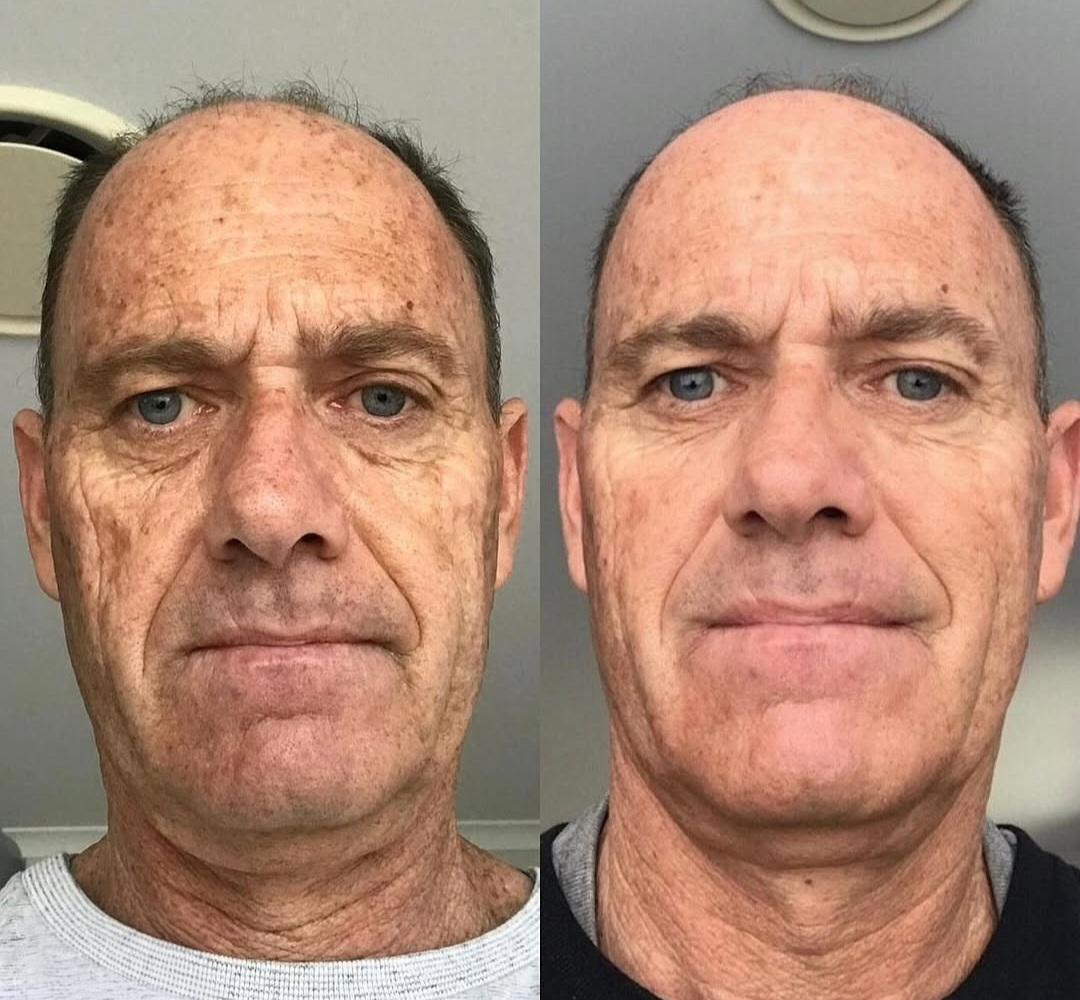 Homecare · Osmosis
The power of the Osmosis skincare and wellness range
Why the MD Advanced serums are professional-only, and what the wellness half of the range is for.
Read article →
The power of the Osmosis skincare and wellness range
Why the MD Advanced serums are professional-only, and what the wellness half of the range is for.
Read article →Most skincare is asked to do its work from the outside only. Osmosis was built on a different premise: that skin repairs best when the surface and the body underneath are treated as one system.
Seven Oaks Skin Therapy prescribes Osmosis for two reasons. The serums are clinical-strength and professional-only, and the range extends past the bathroom cabinet into wellness formulations taken internally. Few skincare brands attempt both, and fewer still make them work as one plan.
Serums are where the corrective work happens. They carry the active ingredients, they sit closest to the skin's own renewal processes, and they are the part of a routine most often chosen at random. Osmosis exists to remove the guesswork from that layer.
Why the MD Advanced collection is professional only
The Osmosis MD Advanced Collection cannot be bought in a shop or from a general website. It is dispensed only through trained skin professionals, and that restriction is deliberate. These are clinical-strength formulations, and their results depend on the right serum being matched to the right skin, in the right order, at the right stage of that skin's repair.
At Seven Oaks that assessment comes first. A Skin Prescription Consultation uses OBSERV imaging, which photographs the skin under different light sources to show pigmentation, vascular activity and barrier condition sitting below what the eye can see. The prescription follows the image, not a shelf talker.
The four core serums
Rescue MD Advanced — Epidermal Repair Serum
Built around patented Trioxolane and madecassoside, a calming botanical extract. Formulated to help reduce the appearance of redness, age spots and environmental damage, with antioxidants and blue-light protective ingredients. The starting point for skin that is sensitive, reactive or recovering.
Catalyst AC-11 MD Advanced — DNA Repair C Serum
Vitamin C with AC-11 and activated amino acids, for radiance, elasticity and the appearance of uneven pigmentation. The serum most often prescribed where tone is the main concern.
Correct MD Advanced and Renew MD Advanced — the retinaldehyde serums
Retinaldehyde in an advanced delivery system, with collagen stimulators and antioxidants, formulated for firmness, texture and the appearance of fine lines. Retinaldehyde is a form of vitamin A the skin converts in fewer steps than retinol. Two strengths sit in the range so the serum can be matched to what the skin will tolerate, rather than starting everyone in the same place.
StemFactor MD Advanced — Growth Factor Serum
An exosome-infused serum using stem-cell and fibroblast conditioned media to support the skin's own renewal processes.
These serums are designed to be layered, and they are applied over an Osmosis activating mist rather than onto damp-from-the-tap skin. Water alone does not activate them. It is a small step that is very easy to skip, and skipping it quietly limits what the rest of the routine can do.
The wellness half of the range
This is where Osmosis parts company with most skincare brands. Alongside the topical range sits a full wellness collection taken internally — Regenerate and Immune Activator are the two most often prescribed at Seven Oaks, but the range is considerably broader than that. It spans skin-focused supplements, elixirs and drops formulated for particular concerns, so the internal support can be chosen with the same care as the serum going on top.
The reasoning behind all of it is straightforward. Skin is an organ, and how it behaves is influenced by what is happening elsewhere in the body — digestion, liver function, immune load, stress, sleep. A serum can only work with the skin it is given. If the conditions underneath are working against it, progress is slower and harder to hold on to.
Sandi tends to reach for the internal support when pigmentation or congestion has not responded to topical work alone, or when there is a clear history behind the skin's current state. It is not a replacement for the serums, and it is not a general wellness add-on. It is the other half of the same plan, chosen at consultation alongside everything else.
What a month can look like
A month is not long in skin terms, but with the topical and internal sides working together it is enough to see movement. One de-pigmentation and liver repair protocol pairs Purify cleanser, the Catalyst AC-11, Rescue and Renew MD Advanced serums over Boost, and Quench moisturiser, with Regenerate and Immune Activator taken internally. Four weeks of that, followed properly, can shift tone visibly enough to photograph under the same lighting and angle.
Individual results vary, and a protocol like that is chosen for a particular skin after assessment, then followed consistently at home. Pigmentation in particular is a long game. It is chronic and relapsing by nature, so daily sun protection and ongoing maintenance are part of the plan rather than an optional extra afterwards.
Where to start
There is no single Osmosis routine that suits everyone, which is rather the point of a professional-only range. A Skin Prescription Consultation at the Cambridge clinic maps what the skin actually needs, and the prescription is built from there, one considered layer at a time. You can also browse the home care range.
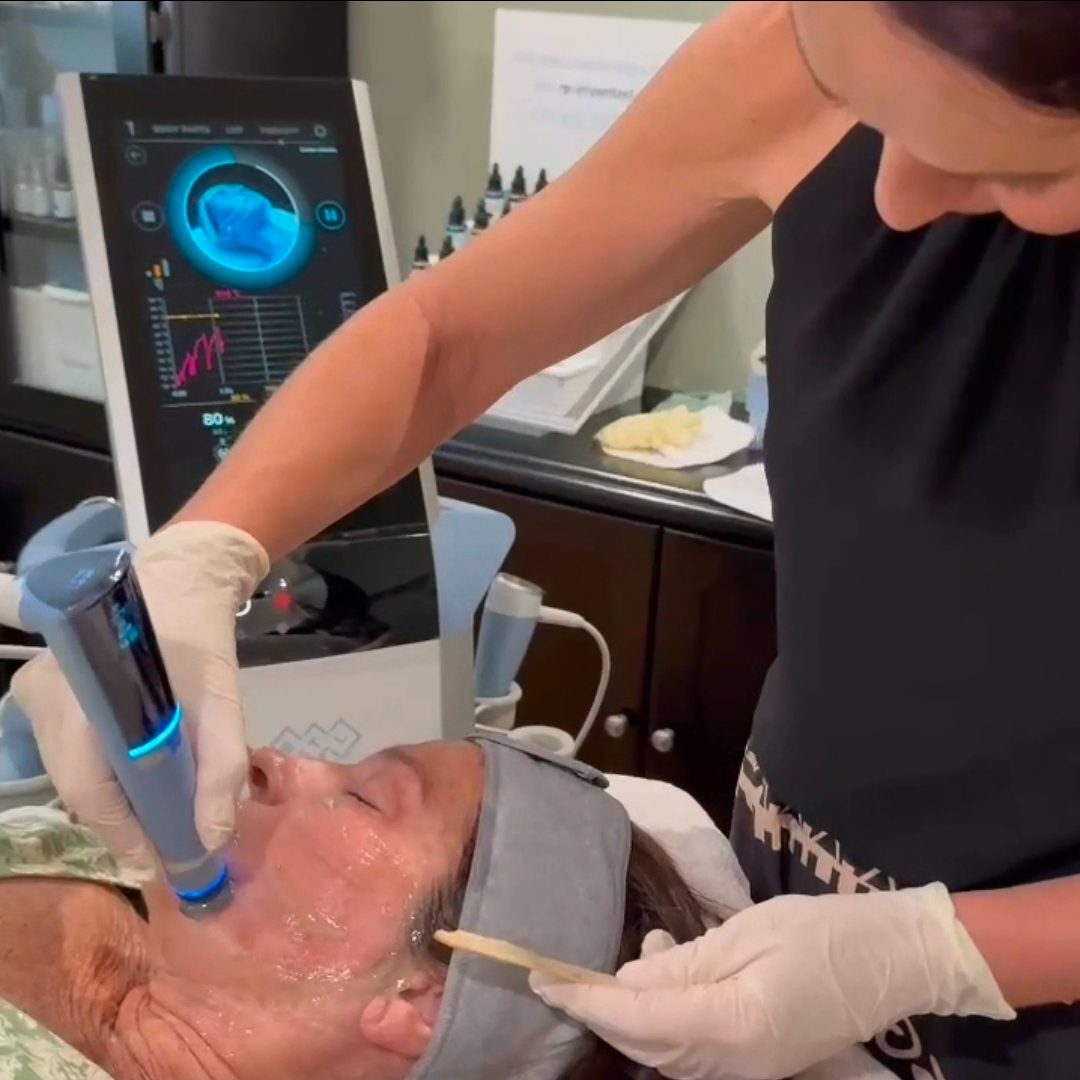 EXION · Cambridge
EXION in Cambridge — what to expect from a course
Advanced skin technology powered by AI — the four applicators, the results clients notice, and why treatments run year round.
Read article →
EXION in Cambridge — what to expect from a course
Advanced skin technology powered by AI — the four applicators, the results clients notice, and why treatments run year round.
Read article →EXION is advanced skin technology powered by AI — radiofrequency and targeted ultrasound working together beneath the surface, where the skin produces its own collagen, elastin and hyaluronic acid. Seven Oaks is currently the only clinic in the Waikato offering it. Expect firmer, smoother, better-hydrated skin with visibly improved tone and texture, and on the body, tighter skin alongside a reduction in localised fat. A course is typically four treatments seven to fourteen days apart for the needle-free applicators, or three to four spaced four to six weeks apart for radiofrequency micro-needling, then maintenance every six to nine months. Treatments run comfortably all year round.
Cambridge is New Zealand's high-performance sport base — rowing on Lake Karāpiro, the Avantidrome for cycling, and an equestrian community that draws riders from across the country. A great many of our clients train outdoors for hours at a time, most days of the year.
That matters for skin more than people expect. New Zealand's summertime UV runs around 40 per cent higher than at comparable latitudes in the northern hemisphere, and cumulative exposure is the single largest driver of visible ageing — loss of firmness, uneven tone, texture change and pigmentation. Skin that has spent years on the water, on the road or in the saddle tends to arrive here needing structural work rather than a facial.
What a course looks like
There are four applicators, and which one suits you depends on what your skin needs — firmness, texture, clarity, or contour on the body. Most clients use one; some combine two across a course.
EXION Face is needle-free, using radiofrequency with targeted ultrasound to encourage the skin's own production of hyaluronic acid, collagen and elastin. Four treatments, seven to fourteen days apart. This is the one for fine lines, dehydration and general loss of firmness.
EXION RF pairs fine microneedles with radiofrequency that reaches further beneath the skin than the needles alone. Three to four treatments, four to six weeks apart. This is the one for deeper lines, acne scarring, enlarged pores and uneven texture.
EXION Clear is a controlled resurfacing treatment for clarity and texture, with less downtime than traditional lasers. Two to four treatments, four to six weeks apart.
EXION Body uses the same technology in a larger applicator, treating localised fat alongside loose skin — abdomen, thighs, arms, bra and back area.
What it feels like, and the downtime
Most clients describe the needle-free applicators as warm rather than painful — comfortable enough that the hour passes easily. Radiofrequency micro-needling involves more sensation, and expect some redness for a day or two afterwards.
The needle-free applicators fit around a normal week without much thought, which is part of why clients keep to a course. Everyday sun protection is worth being consistent with afterwards, as it is with any skin investment.
Advanced skin technology, powered by AI
What sets EXION apart is intelligence rather than intensity. The platform monitors the skin continuously during treatment and adjusts its energy delivery in real time, holding the tissue at the temperature where collagen remodelling happens without pushing past it. Nothing is added to the skin — everything you see afterwards, your own body has made.
It is also the reason EXION suits skin all year round. Because the energy is regulated rather than ablative, treatments run comfortably through summer as well as winter, so there is no need to wait for a season to start.
What clients notice
Hydration and a smoother, softer feel tend to arrive first, often within the first two or three sessions. Firmness follows — a more defined jawline, tighter skin across the cheeks and neck, and fine lines that soften as the skin thickens from within. On the body, skin that had lost its tone begins to hold its shape again.
Because EXION works by prompting your own collagen, elastin and hyaluronic acid production, the improvement continues developing for weeks after your final treatment, and maintenance every six to nine months holds what you have built. It is a genuine investment in the long-term quality of your skin rather than a temporary result.
Who it suits, and who it doesn't
EXION suits skin that is starting to lose firmness, skin with texture or scarring to address, and clients who would rather not have injectables or surgery. It is not the right answer for everything — significant sagging responds better to a structural lift, and a compromised barrier needs settling before any energy-based treatment. That is a conversation for your consultation rather than something to decide from a website.
We see clients travelling from Hamilton, Te Awamutu and further afield in the Waikato. If you are coming a distance, we will build the course around appointments that are worth the drive.
A consultation is the starting point for any EXION course. You can see the investment by applicator on the price list, or read the full treatment detail.
 Pigmentation · Waikato
Melasma treatment in the Waikato — why we run pigmentation courses in winter
High UV, outdoor sport and the case for treating pigment April to October.
Read article →
Melasma treatment in the Waikato — why we run pigmentation courses in winter
High UV, outdoor sport and the case for treating pigment April to October.
Read article →Melasma and sun-related pigmentation are treatable, but they need different approaches — and choosing wrongly can make melasma worse by driving pigment deeper into the skin. Our Méline pigmentation courses run April to October, through the Waikato's cooler months, because lower UV gives the skin the conditions it needs to hold a result. Every course begins with a dedicated consultation, and the plan is confirmed before any treatment is booked.
Pigmentation is the most common concern we see, and in this region that is no accident. Cambridge is a town built around outdoor sport — rowing at Lake Karāpiro, cycling, and one of the country's largest equestrian communities. Add farming, gardening and school sport on the sideline, and a great many people here accumulate far more UV exposure than they would in a city.
New Zealand's summer UV runs around 40 per cent higher than comparable northern-hemisphere latitudes, and this country has among the highest melanoma rates in the world, with more than 50,000 skin cancers diagnosed annually. Pigmentation is the visible end of the same story.
Telling the two apart
Sun spots — solar lentigines — are small, flat and clearly defined, usually round or oval, appearing where the sun has reached most: cheekbones, nose, forehead, backs of the hands, chest. They are the record of accumulated exposure, with no hormonal component, and they build gradually over years.
Melasma appears as larger, blotchy patches with soft or indistinct borders, and it is typically symmetrical across both sides of the face. It arises from a combination of hormonal influence, family history and sun exposure — pregnancy and hormonal contraception are common triggers, which is one reason the American Academy of Dermatology reports only around 10 per cent of cases occur in men. It appears only on the face, it is aggravated by heat as well as light, and it tends to recur.
That last point is why the distinction matters so much. Aggressive heat or light-based treatment suited to sun spots can set melasma back considerably. It is also why we assess before we treat rather than the other way round.
Looking beneath the surface
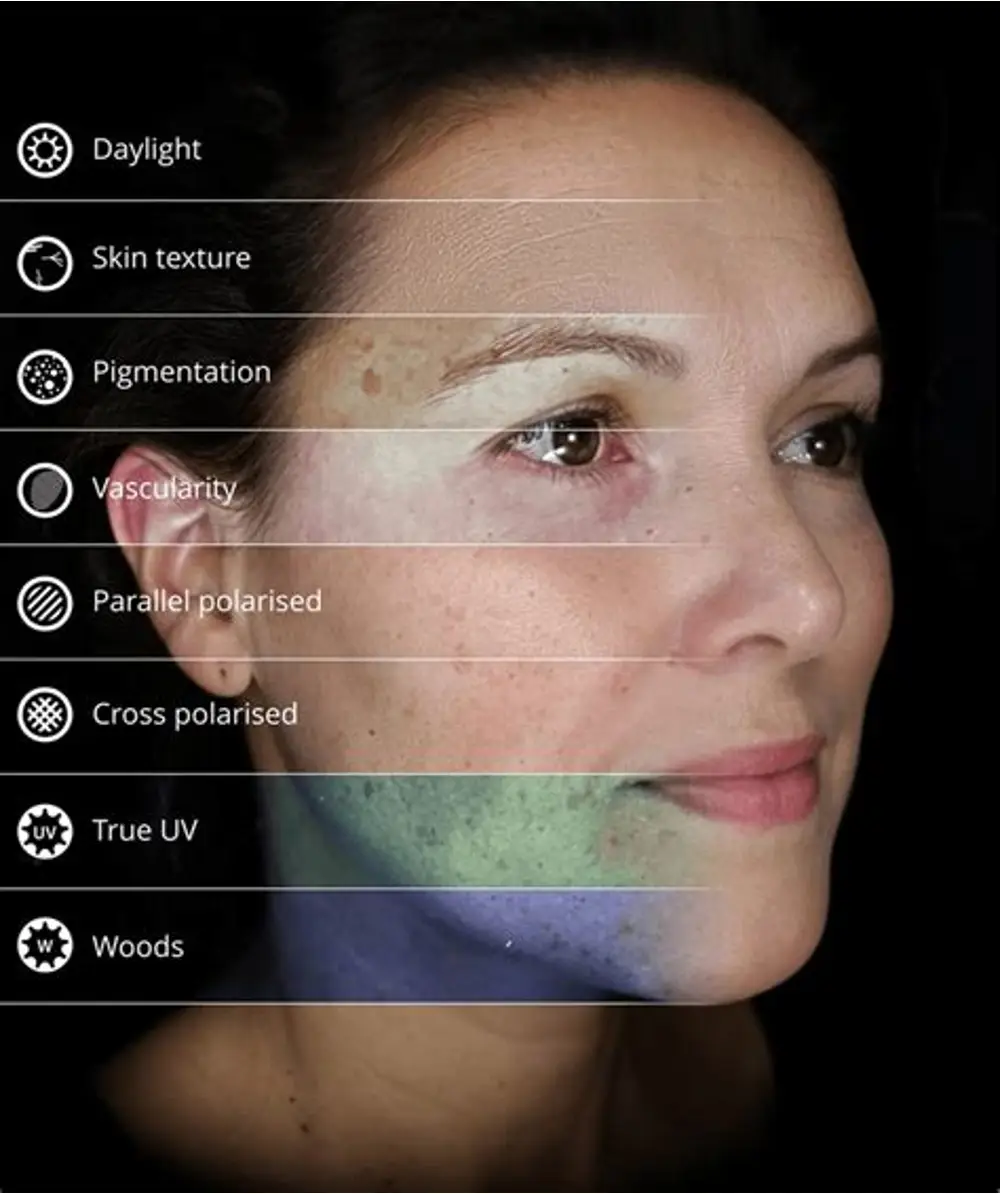
Distinguishing the two properly means assessing symmetry, pattern and the depth of the pigment — dermatologists use a Wood's lamp for the same purpose, separating pigment sitting in the epidermis from pigment sitting deeper. We use the OBSERV skin diagnostic device, which photographs the skin under different types of light so we can see pigment below the surface before it becomes visible in the mirror. That tells us how deep it sits and how much more may be waiting, which in turn tells us which protocol is appropriate.
With sun spots the pigment often sits more superficially, in the epidermis, which is part of why well-chosen targeted treatment does well with them. Melasma frequently sits deeper, and that depth is what shapes which protocol is safe to use.
For clients who train outdoors, this is often the moment things click. Pigment that has been accumulating for twenty years on the water or in the saddle is visible in those images long before it surfaces.
The Méline protocols
Méline Pigmentation Package combines two professional peels with two medical micro-needling treatments using Méline ID, spaced two weeks apart, alongside a prescribed home-care system that regulates melanin production and helps prevent recurrence.
Méline ID Transdermal uses micro-needling to deliver depigmenting actives more deeply, for dermal melasma. Generally three to four treatments, four weeks apart.
Méline Spots is the targeted treatment for solar lentigines and sun damage, applied directly to the marks themselves.
Home care is not an optional extra with any of them. It is most of the result, and it continues after the in-clinic treatments finish.
Why April to October
Treating pigment through a Waikato summer works against you. Lower UV through the cooler months gives the skin the best conditions to hold its result, and it means the months of strict sun protection that follow a course are genuinely achievable rather than aspirational.
For anyone training or competing outdoors, that timing is worth planning around. If your season runs through summer, starting a course in April gives you the whole winter to work with.
Melasma in particular is a condition to manage rather than a mark to remove, and we would rather tell you that at the outset than promise otherwise. A Méline consultation is the starting point, and the fee is redeemable against your treatment protocol.
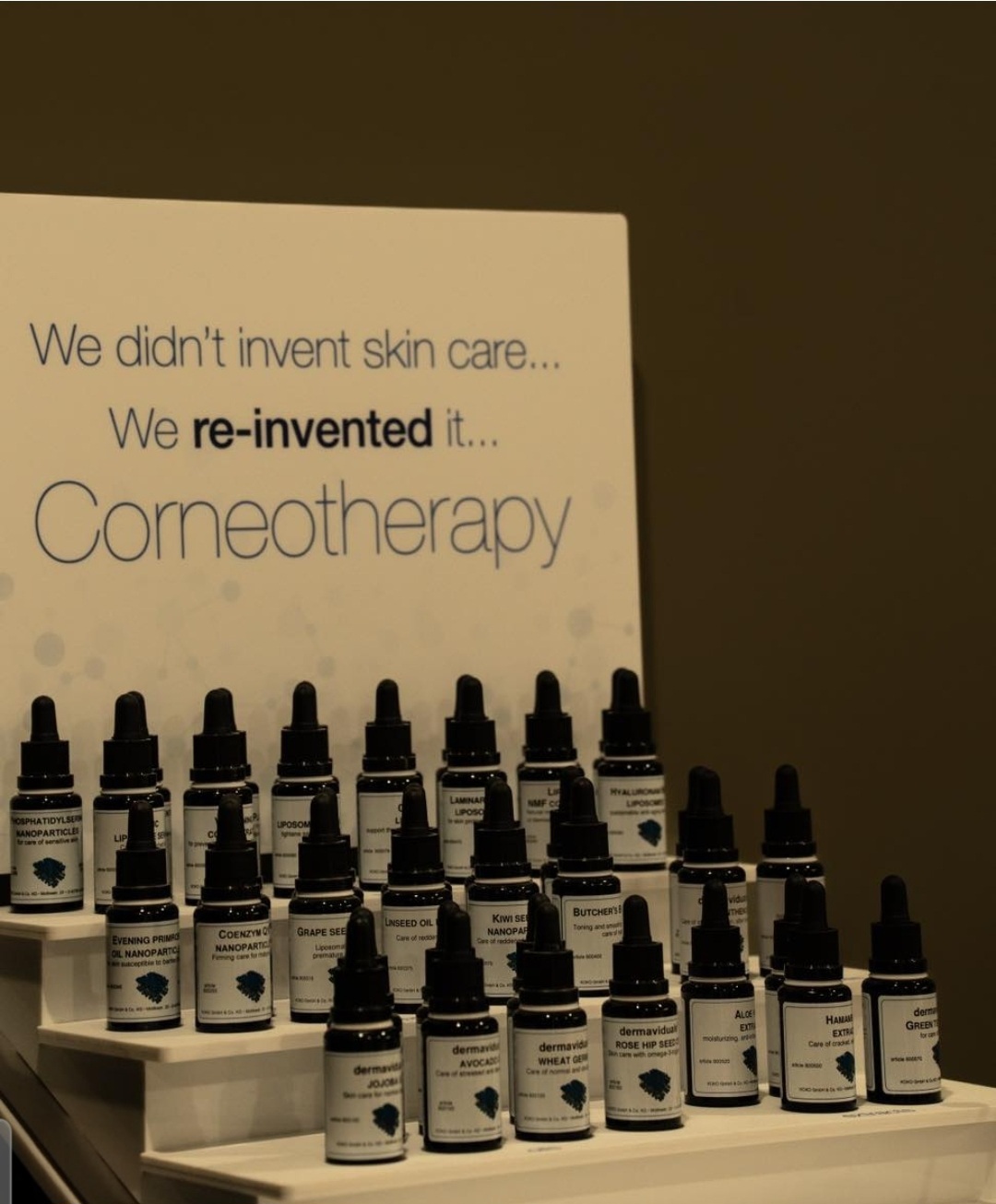 Skin Science
What is corneotherapy, and what does it mean for your skin?
Why we repair the barrier before anything else — and the 1960s discovery behind it.
Read article →
What is corneotherapy, and what does it mean for your skin?
Why we repair the barrier before anything else — and the 1960s discovery behind it.
Read article →Corneotherapy is an approach to skin care built on repairing and maintaining the skin's outer barrier — the thin protective layer that holds moisture in and keeps irritants out — rather than stripping it back. In practice it means gentler treatments, products without the ingredients that commonly provoke a reaction, and a plan built around restoring how your skin functions rather than scrubbing away what you can see.
The layer in question is the stratum corneum, the outermost part of the epidermis. For a long time it was assumed to be little more than dead cells on their way off the surface. In the 1960s the American dermatologist Dr Albert Kligman — co-inventor of Retin-A — and his colleagues established that it is biologically active tissue, and that the stratum corneum and the lipid barrier holding it together send signals to the living epidermis beneath, influencing regeneration in the deeper layers. Kligman later gave the resulting body of practice its name: corneotherapy.
Why stripping the skin backfires
When the barrier is intact it holds water in the skin and keeps irritants and microorganisms out. When it is compromised — often through over-exfoliation, harsh surfactants or an active introduced too quickly — water escapes, irritants get in, and the skin shows it: redness, flaking, tightness, itch, rough texture, breakouts that will not settle. Researchers measure this as transepidermal water loss, essentially how much moisture is escaping through the surface.
The squeaky-clean feeling many of us were taught to associate with a proper cleanse is usually the barrier having just lost lipids it needed. The skin then compensates, which is why oily skin can become oilier and dry skin drier on a routine that is meant to be helping. The corneotherapy position is that the epidermis should be intact at all times, and that little can be corrected while the barrier is still struggling.
What this looks like at Seven Oaks
We work with Dermaviduals, a range built on these principles. There are no fragrances, conventional emulsifiers, preservatives, parabens, silicones, mineral oils or colours in it. Its base creams use a structure with a direct affinity to the skin's own cell membranes, and its active serums are encapsulated in liposomes — tiny spheres that fuse with the skin's own layers to carry actives where they are needed. Each formulation is mixed in the studio for one person, prescribed at consultation and adjusted as the skin changes.
In treatment the same thinking applies. Enzymes rather than scrubs, actives chosen for the state of your skin on the day, and hydration layered back in before you leave.
How long it takes to notice
Comfort usually comes first — less tightness, less reactivity. Tone and texture follow, because the skin renews on its own schedule: a keratinocyte takes roughly 28 days to travel from the base of the epidermis to the surface and shed. There is no shortcut around that, and clients who have spent years cycling through products often find this the most reassuring part.
If your skin has been unpredictable for a while, a Comprehensive Skin Consultation is the sensible starting point. We look at the barrier first and build from there.
 Homecare
How many skincare products do you actually need?
Four products, used consistently, beat twelve you never reach for.
Read article →
How many skincare products do you actually need?
Four products, used consistently, beat twelve you never reach for.
Read article →Four, for most people: a cleanser that suits your skin, one active serum chosen for your main concern, a moisturiser, and sun protection. Four products used consistently will do more than twelve used sporadically, because skin responds to repetition rather than variety. What matters is that each one is right for your skin, and that you use it long enough to see what it does.
Most of the bathroom cabinets we hear about have the same story behind them. Something was recommended, something else was on offer, a friend had good results with a third thing. None of it was chosen as a set, and quite a lot of it works against the rest.
Your skin already knows what it is doing
It is worth remembering what the organ we are trying to improve actually does. Your skin senses touch, registers heat and cold, and holds the whole body together. It stands between you and a world of pathogens and toxins. It draws blood away from the surface when you are cold and raises the hairs on your arms, flushes to shed heat when you are warm, sweats to cool you, and helps clear what the body no longer needs. It renews itself continuously, without being asked.
That is an intelligent system, and a well-looked-after one does not need a great deal of help to look and feel good. Most of what we see in the clinic is not skin that has been neglected — it is skin that has been overruled. Less genuinely is more, and getting there is usually the goal.
Order matters more than quantity
Work from thinnest to richest: cleanse, then mist if you use one, then serum, then moisturiser, with an oil last if your skin likes one. A mist leaves the surface lightly damp, which helps whatever follows spread and absorb rather than sit on top.
Sun protection is the one non-negotiable
New Zealand guidance is a broad-spectrum, water-resistant sunscreen of at least SPF30 and preferably SPF50+, applied about 20 minutes before you go out and reapplied every two hours. Protection is recommended whenever the UV index is 3 or above, which in the Waikato covers a great deal of the year. Worth remembering too: UV cannot be seen or felt. What you feel is infrared heat, which is why a cool, overcast summer day will still burn you — and why pigmentation work undone by three unprotected weekends is such a familiar story.
Give things time
A skin cell takes around 28 days to move from the base of the epidermis to the surface, so a fortnight is rarely long enough to judge a product. Introducing one new thing at a time also means that if your skin objects, you know exactly what it objected to. Three new products at once tells you nothing useful.
Where prescribed products change things
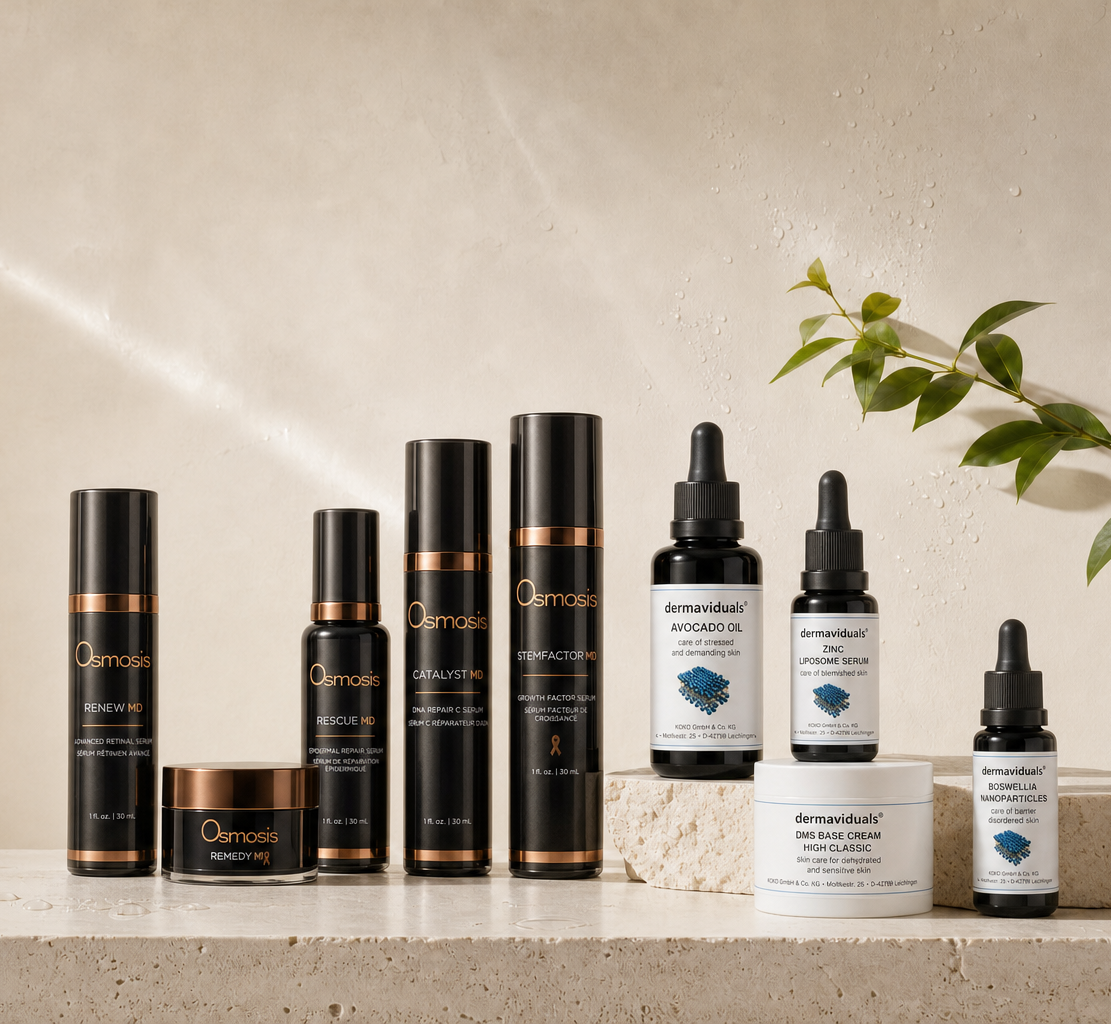
With Dermaviduals, the formulation is mixed for you — a DMS base cream plus the active concentrates your skin needs this season — which removes a lot of the guesswork. Their cleansers and moisturisers carry no fragrance, emulsifiers or preservatives, so there is less for reactive skin to argue with. The Osmosis MD range is professional-only for the same reason: formulas like Rescue MD, Catalyst MD and StemFactor MD are strong enough that they should be prescribed alongside a plan rather than bought on a hunch. For daily protection we use SIMKA — the Sheer Mineral Milk and Invisible Facial Fluid at SPF 50, and their Prebiotic Peptide Day Cream. Either way the routine gets adjusted as your skin changes, rather than staying fixed for years.
What to stop doing
Daily exfoliation. Cleansers that leave the skin tight. Layering several strong actives in one evening because each was individually recommended. And swapping the whole routine every time something new appears — the skin you are trying to settle needs a period of not being surprised.
Bring what you are currently using to your next appointment. Knowing which ingredients have already left their footprint on your skin helps us prescribe around them, so a new plan settles in rather than provoking a reaction. You can also browse the home care range.
 HIFU
HIFU
What can HIFU realistically do, and what can't it?
What a 2025 review of 45 studies found — and what the treatment cannot do.
Read article →
What can HIFU realistically do, and what can't it?
What a 2025 review of 45 studies found — and what the treatment cannot do.
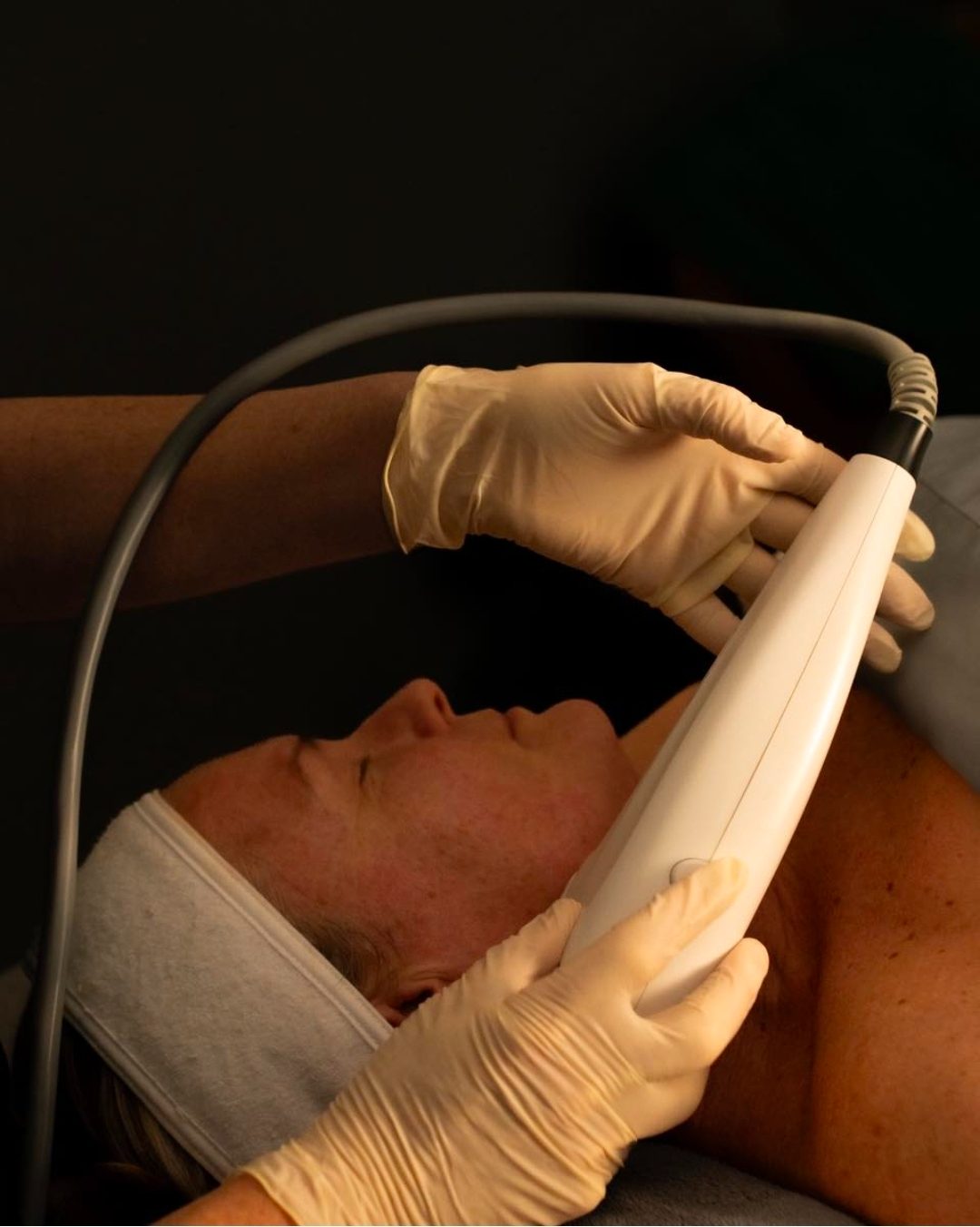
Read article →HIFU — high intensity focused ultrasound — works on the structure of the skin, lifting and tightening tissue that has become lax. The published evidence is strongest for the lower face, neck and area around the eyes. What it cannot do is remove significant excess skin or replace a surgical facelift, and it will not treat pigmentation, texture or fine surface lines. Those need something else.
The treatment delivers ultrasound energy between 3mm and 4.5mm into the dermis, the deeper layer of the skin. Unlike laser or surgery, it bypasses the upper layers entirely to place energy at a specific depth and temperature. That causes a controlled injury, and the body responds by remodelling its own collagen — which is where the lift comes from.
What the evidence shows
A 2025 systematic review in the Aesthetic Surgery Journal pooled 45 clinical trials and cohort studies published between 2010 and 2024. It found meaningful improvement in skin laxity of roughly 18 to 30 per cent, strongest in the lower face, neck and periorbital area, and for body treatment a reduction in circumference of 2.5 to 4.5cm, mostly abdomen and thighs. On safety, fewer than 5 per cent of patients reported side effects, and those were transient — redness, swelling or mild discomfort.
The same review is candid about the gaps: protocols are not yet standardised across devices and practitioners. Worth knowing, and worth being wary of anyone who tells you otherwise.
Who it suits
Generally clients over 35 who want a lift or tightening of the jawline, chin, brow or neck and are not looking for surgery, or who want to slow the pace of facial ageing. It also suits loose skin on the body — abdomen, upper arms, above the knees — where firming is the goal.
The honest bit about timing
This is not a treatment you walk out of looking transformed. Because it works by prompting your own collagen remodelling, the lift builds over weeks to months, and results continue improving for up to twelve months afterwards. Clients who expect an immediate change are often disappointed at two weeks and delighted at three months. It is worth knowing that in advance.
Downtime, and the course
Downtime is minimal, which is where the lunchtime facelift nickname comes from. An initial course of two treatments eight weeks apart, then a maintenance treatment every 9–12 months to hold the result. HIFU also combines well with treatments that work on skin quality — the review notes better outcomes when it is paired with other modalities — so for some clients a combination with EXION is the sensible plan.
Whether structure is actually your issue is the first thing we establish. See HIFU skin tightening.
 The Studio
Why does a skin consultation come first, every time?
What we look at with OBSERV, and how a skin plan gets built from it.
Read article →
Why does a skin consultation come first, every time?
What we look at with OBSERV, and how a skin plan gets built from it.
Read article →Because what you can see on the surface rarely explains itself. A consultation lets us look at what is happening beneath the skin, understand what is driving it, and choose a treatment that addresses the cause rather than the symptom. It is also how we avoid recommending something expensive that was never going to help — and, with pigmentation in particular, how we avoid a treatment that could make things worse.
Two people can arrive with what looks like the same concern and need entirely different plans. Redness might be a compromised barrier, or rosacea, or a reaction to a product bought last month. Congestion might be genuine congestion or a barrier that has stopped functioning. In dermatology the same principle holds: accurate diagnosis comes before treatment selection. Any skin concern can be made worse by the wrong prescription — a barrier pushed further out of balance, breakouts provoked rather than settled, redness inflamed — and with pigmentation in particular the wrong choice can drive pigment deeper rather than clear it.
What happens in the room
We start with the OBSERV skin diagnostic device, which photographs the skin under different types of light to show what sits below the surface — dehydration, pigmentation, congestion, redness and early signs of ageing not yet visible in the mirror. Seeing your own skin this way tends to be the moment things click.
From there we work through Osmosis Skin Mapping, which connects internal factors — lifestyle, stress, nutrition, general health — with how they are presenting on your skin. Then we assess the health of your barrier using Dermaviduals corneotherapy principles: how well your skin is currently protecting itself, and what it needs in order to do that properly again.
What you leave with
A tailored skin plan: treatment recommendations in a sensible order, home care guidance, and a realistic sense of the timeframe. If the honest answer is that your barrier needs a few months of settling before we go near an advanced treatment, that is what we will say. It is not the quickest route to a booking, but it is the one that works.
Who it's for
New clients, anyone with a specific concern they have not been able to shift, and anyone who wants a considered plan rather than a series of unrelated appointments. Méline pigmentation programmes have their own dedicated consultation, which is required before any Méline treatment is booked.
Book a Consultation